| Return to BBCtvLicence.com Main Menu |
Detector vans
A major weapon in the arsenal of TVL/BBC is the Detector van. Or is it?
Letters reproduced on this site periodically refer to "electronic detection equipment":
My view is that, so long as it is not causing an obstruction, the BBC may leave a detector van outside my property as often as they wish. I do not care.
But, out of curiosity, from time to time, I look out of my window to see if I can spot one. So far, I have not seen any. In fact, I have never seen a detector van anywhere, anytime.
A letter to the BBC under the Freedom of Information Act asked how many vans there were, and how many were in operation on a given day, but the BBC declined to provide an answer.
Divulging the number of vans does not, in itself, prevent their effectiveness, any more than knowing the number of police cars undermines the police. Public knowledge that there is a large number of detector vans might be expected to increase prevention rather than reduce it. Therefore, the BBC's refusal to answer implies that the number of detector vans is small.
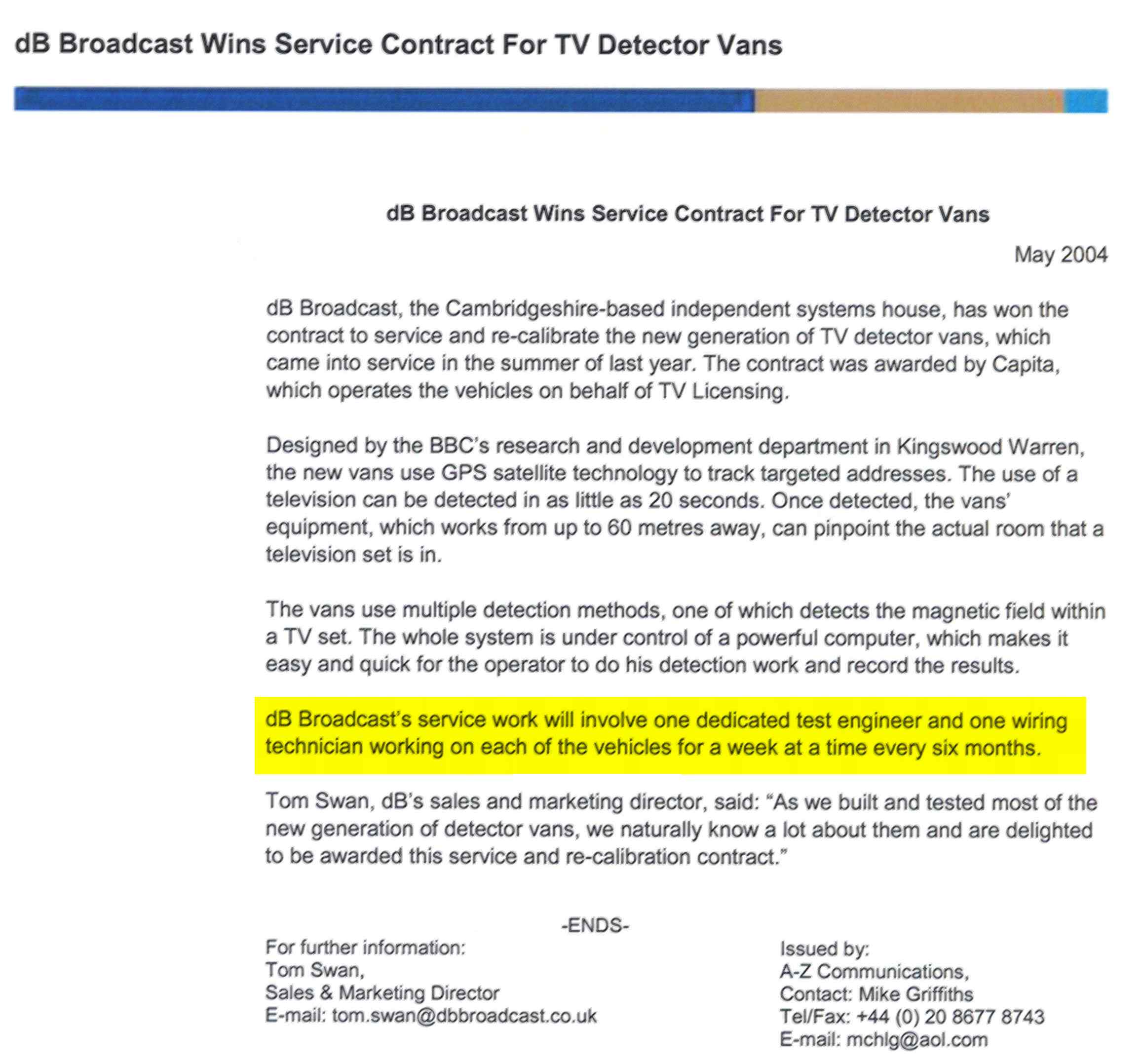
The possible number of detector vans is provided by DB Broadcast, the company that services the vans. This scan is from their website:
The highlighted paragraph says that there are two dedicated members of staff working on each of the vehicles every week, completing the vans in a six month period. The conclusion to be drawn is that there are 26* vans.
26* vans, less one for servicing at any one time, is not a particularly large number and accounts for why they are not commonly seen on the roads. By way of comparison, most people have seen Securicor vans; there are 1,900 of these. Such a small number of detector vans is consistent with the BBC's unwillingness to divulge the number, since making it known that there are so few might "prejudice the prevention...of crime..."
*Update, August 2009: new evidence has led to the estimate of 26 vans being revised downwards. Please see Freedom of Information - own goal for BBC, further down this page for information and analysis. How important are these vans in tracking down rogue television sets?
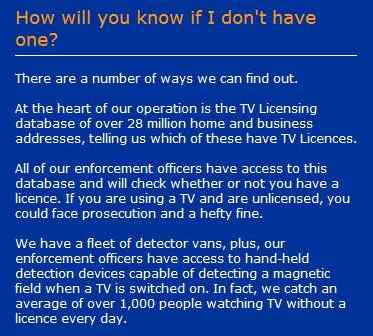
The TVL website contains the following:
tvlicensing.co.uk - 1 February 2007The second and third substantive paragraphs are not remarkable. Obviously, TVL/BBC knows which households do not have licences, since TVL/BBC is responsible for issuing them. Illegality concerns the unlicensed receiving of broadcasts, so only the final paragraph is relevant.
Note how the final paragraph is structured. The first sentence describes detector van capabilities. The second says that over a thousand people are caught every day. The impression created is that detection devices are responsible for catching more than a thousand people every day. But the paragraph does not actually say this; it is the running of the two sentences together in the reader's mind that leads to this conclusion, encouraged by the insertion of the term 'in fact'.
TVL/BBC also seeks to impress with use of GPS satellite technology:
tvlicensing.co.uk - 1 February 2007
GPS (Global Positioning System) is a tool for navigation, not detecting the receiving of broadcasts. For those who are unfamiliar with GPS, it is an electronic atlas, whereby roads and street numbers are stored on a database and a synthisized voice tells the driver where to drive ("turn right, turn left"). GPS devices are available for purchase at electrical stores and powered from the vehicle's cigarette lighter.
The sole benefit of GPS to TVL/BBC is that it saves them looking at a map when driving. Expressions such as GPS will help "target individual evader homes" are misleading, since they imply that satellite technology contributes to the detector capabilities of the van. It doesn't.
Hand-held devices
TVL/BBC also employs the use of hand-held detectors; according to the TVL website, they make it "...easy for us to locate TVs, even in the hardest to reach places". These devices are produced by Buckman Hardy Associates; here is a scan from their website:
buckman-hardy.co.uk - 1 March 2007But can these detection devices actually detect a television?
If it is possible to place a man on the moon and split the atom, it would be surprising if it was not possible to detect a television on the other side of a wall. The following is a question put to the BBC under the Freedom of Information Act:
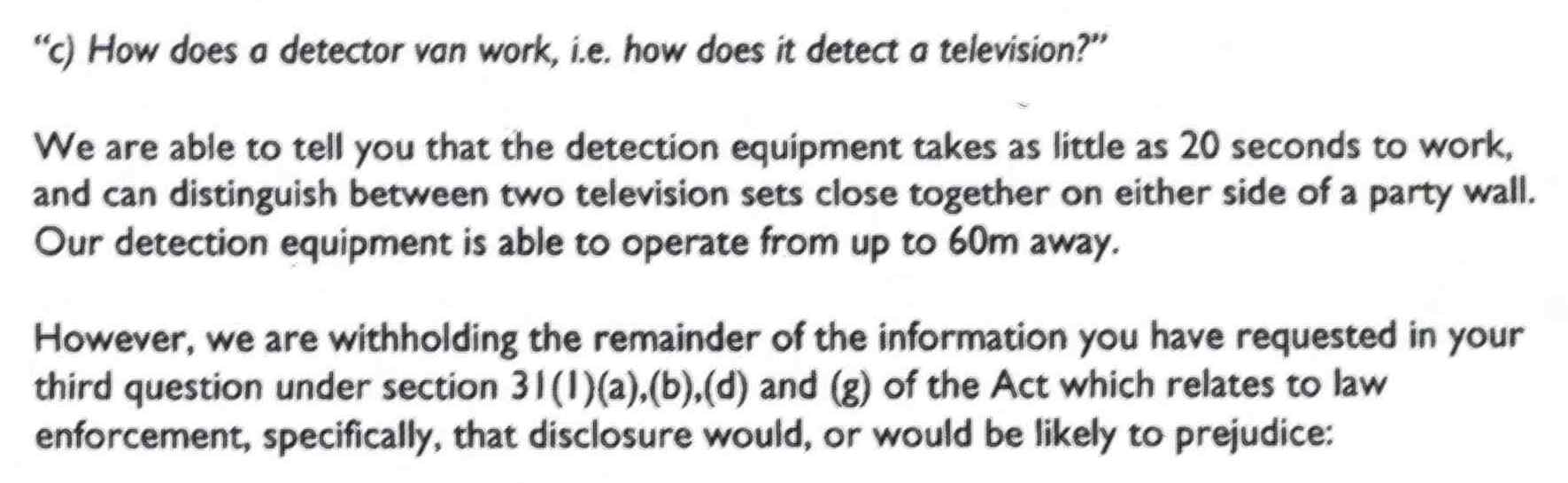
Thus, the BBC confirms that detector equipment exists, and says that it can detect within 20 seconds, but details on how it does this are withheld.
The TVL website also opts for secrecy on how detector vans work:
tvlicensing.co.uk - 1 February 2007If TVL/BBC technology is secret, what role can it play in the legal enforcement process?
The answer is none. Courts cannot convict without evidence, and evidence cannot be heard unless it is available to both prosecution and defence. Since TVL/BBC is unwilling to divulge the inner workings of a detector van, its evidence cannot be used in a prosecution.
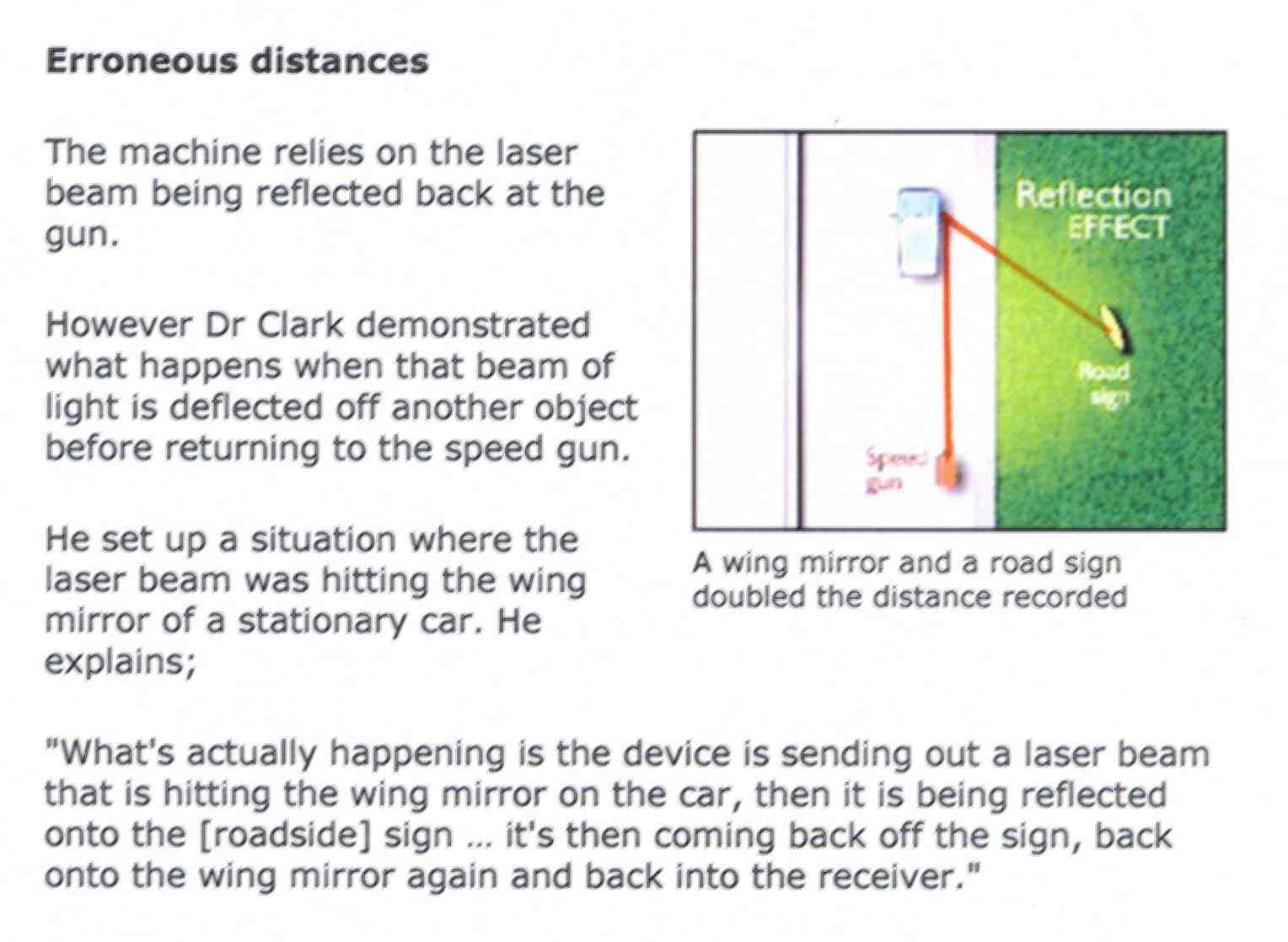
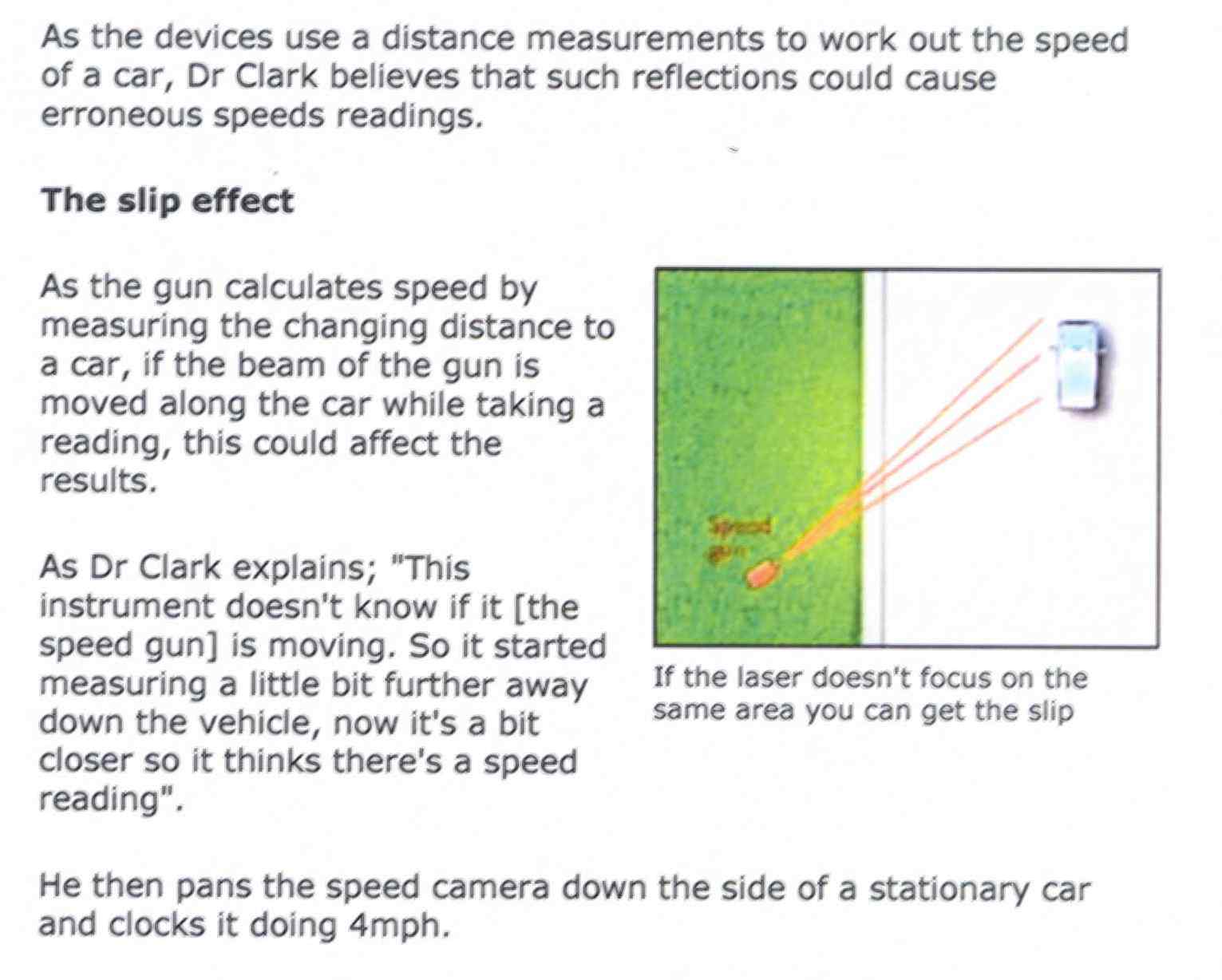
Compare the lack of public knowledge on detector vans to speed cameras. Speed cameras are subject to scrutiny. Here is a scan from the BBC's website which does just that:
Faulty or inaccurate speed cameras will cause injustice and bring the speed enforcement process into disrepute. It is in the interests of both motorists and enforcers to make the technology of speed cameras known, for scrutiny ensures credibility, and credibility secures convictions when the speeding laws are broken.
For TV detector devices to be credible, we have to know that they are reliable and accurate. Here is a question on the testing of vans, put to the BBC under the Freedom of Information Act:
The final sentence says, "calibration records...are not available for viewing by the public".
If the public do not have access to the calibration records, nobody outside TVL/BBC can know whether the vans are working correctly. Consequently, any information obtained by the vans cannot be used in an evidential way.
Detector vans - or Dummy vans?
The above observations are based on the assumption that BBC/TVL uses whatever detector technology is available to it. However, there is an alternative view that says detector vans are a myth, cultivated by the BBC to make people think that detector technology is used. This view acknowledges that vans themselves exist, but argues that they are empty; they are dummy vans rather than detector vans.
This view is given credence by exchanges which occasionally appear on the internet. The following have been selected because the writers claim some degree of inside knowledge, or have seen inside a TV detector van.
Posted February 2010
I used to work for TV licencing driving around in the detector van. It was full of fancy looking equipment for show only, NONE OF IT WORKED! They have a database of the houses without licences which they got by selecting streets and looking at who HAS got the licence. The remaining are targeted.
Leaflets will be dropped through those doors advising them to buy a licence as the TV detector van will be in the area in two weeks time. After driving around the area for days on end in a highly visible van with large antennae, leaflets are dropped again through the doors saying they have been picked up by the van and need to buy a licence or face prosecution. Most people pay.
Posted January 2007
Sir Wendy - The TV licensing agency apparently has vans which can detect TVs and vcrs in unlicensed properties, but I've never seen them and nor has anyone else.
Sinner Boy - I've seen them, but they don't have detectors. They have a list of unlicenced addresses and they go round in the evenings, when they can see the glow through the window. Then they knock on the door and say, "Hello, we've detected a telly in your left hand back bedroom" Then they ask to come in for a look. My mother's ex-boyfriend used to work for them and told us.
Posted September 2005 (edited)
Dilzybhoy - I had a mate who drove about all day in a "detector" van. He was employed to drive around the schemes with the van with the big aerial and "TV detector Van" plastered on the side. It had nothing in it apart from his sleeping bag and some clothes ... I'm not making it up. I've seen inside it ... Twas in 2000 I was in this "detector" van.
Posted April 2005
clive - Regarding this license threat malarky. I happened to be in a petrol station whilst one was filling up and saw in the back of this tv detector van, absolutely empty, it might not be the case in all detector vans but I would imagine a fair few are decoys.
Doubts that detection equipment is used is also given weight by a TVL/BBC announcement in 2003 that detector vans will henceforth have removable TVL logos:
The press release says that the lack of identifying features on the vans is intentional; people aren't supposed to see them. But the implication is that neither detector vans nor dummy vans need be used for the BBC to persuade the public that they are still in use, since the BBC need only refer to their 'covert' nature to account for their absence from the streets.
Freedom of Information - own goal for BBC
In 2006, a member of the public complained to the Information Commissioner about the BBC's refusal to release information on detector vans under the Freedom of Information Act. After considering BBC representations, the Information Commissioner rejected the complaint.
However, in providing his Decision Notice (to read in full, click here), the Information Commissioner provided the reasons provided by the BBC for not wanting the information released. In short, the BBC had said that the effectiveness of detector vans depended on perception, and that if the public actually knew the number of vans, and how often they were used, detector vans would no longer be a deterrent.
Key paragraphs are as follows:
21. The BBC explained that the number of detector vans in operation, the location of their deployment and the frequency is not common knowledge. It relies on the public perception that the vans could be used at any time to catch evaders. This perception has built up since the first van was launched in 1952 and has been a key cost effective method in deterring people from evading their licence fee.
22. The BBC state that to release information which relates to how often detector vans are used will change the public’s perception of the effectiveness of detector vans. If the deterrent effect of television detector vans is lost, the BBC believes that a significant number of people would decide not to pay their licence fee, knowing how the deployment and effectiveness of vans will affect their chances of success in avoiding detection.
28. The Commissioner has viewed the withheld information and is satisfied that disclosure of the information would be likely to have the adverse effects discussed above...
30. The Commissioner recognises the importance the BBC places on the public perception of the use of detector vans, and he also recognises that disclosure of this information would change this perception...
But that's not all. The Decision Notice made the following finding of fact:
13. The information being withheld consists of 32 documents which include the following information:
• Authorisations of detection of television receivers from outside residential or other premises;
• Internal emails and file notes which relate to the request and other similar requests;
• Other internal TV licensing documents.
The Information Commissioner indicates that there were fewer than 32 authorisations for the use of detectors. This disclosure may have provoked an irate reaction from the BBC, since a later Decision Notice, again relating to detector vans and virtually identical to the one above, omits the number of detector authorisations. Examine it here.
How many working detector vans? A reassessment
The member of the public's FOI request that led to the disclosure of 32 documents was submitted in July 2006; the request was for documentation that "…stretches back to the beginning of 2004". So, the 32 documents may cover a period as long as 30 months, from the beginning of 2004 to mid-2006.
The Information Commissioner says the 32 documents include emails, file notes and other TV licensing documents. These extra documents are all referred to in the plural, so there must be at least two of each, therefore accounting for no fewer than 6 of the 32 documents. This leaves, at most, 26 authorisations for detector van deployment.
26 authorisations in 2½ years compels a reassessment of the previous estimate that there are 26 detector vans, for each van could have been used, on average, only once in that lengthy period. Not even the BBC can be that inefficient. So, the conclusion may be drawn that that there are fewer than 26 vans.
In May 2009, the BBC awarded a new contract for detector vans. The contract award (read in full here) includes the following sentence:
The objective will be to enhance the current fleet of vans by building a further fleet of vans (minimum of 5) to come into service from April 2009.
The contract award says that the BBC currently has one fleet, and wishes to add a further fleet. It identifies the figure of five vans to a fleet, or possibly six, since it specifies five as the minimum. This implies that, prior to 2009, the BBC had five or six detector vans.
With this figure in mind, it is worth recalling the promotional picture of detector vans that featured on contractor dB Broadcast's website in 2006 (since removed). This shows precisely six vans:
Source: www.dbbroadcast.co.uk
At the time of the photo, it was assumed that these were six of the 26. But when considered against the evidence contained in the Information Commissioner's report and the contract award, this photo may be more accurately interpreted as showing the entire fleet.
Conclusions
(1) Between 2003 and 2009, there were six working detector vans. Each of these was deployed several times a year. This low number of vans and deployments accounts for the BBC's view that release of this information would end their deterrent effect.
(2) In 2009, the BBC commissioned five more working vans. Thus, as of 2009, there are eleven vans. This does not preclude the possibility that the new fleet is replacing ("enhancing" in the contract award) the previous one, in which case there will fewer than eleven working vans.
(3) In addition, there are dummy or publicity vans that appear in supermarket car parks and other public places. Since the working vans are used so infrequently, it is likely that they spend most of their time in this capacity. At least two vans seen performing this role (see Detect the Detector vans, LT03TYV and Y254CGO) are of the type in the above dB Broadcast photograph.